Showing posts with label Greece. Show all posts
Wednesday, April 4, 2018
The Museums of Archaeology
While greeting at the Virtual Worlds Best Practices in education I met Qvintvs Petilivs Secvndvs (SeverusAlexander Resident). I learned that he is an owner of the Museums of Archaeology in Second Life. I decided to visit the museum since it was completely new to me.
What a wonderful place this is for those who have an interest in history in general and those who love to visit regions with builds that are enticing,builds related to the past or to places we never expect to visit in real-life.
The Hub is the landing place where there is a gift shop featuring lovely ancient items that come from the various museums, a library filled with enough information to possibly acquire a degree. Some is on notecards , some on the web. Pick up a hud there when you land,that will guide you to the venues. There are also teleports at every stop.
I went to the Orbis Romanus first to visit an ancient urban area and view the monuments . At the entrance there is a map showing all the areas in the build. As you pass through the gates you feel the change of the of the time as you enter the ancient city . This would have been a wonderful way to learn about the building and columns of the past instead of looking at a flat book page. Listen to the sounds of the city as you walk. Information balls are on every build along with pictures of reconstruction and the original site of the building. It is an education!
My next stop was at the Ortem Project where you will see a collection of amazing inventions of the Roman times. A hall filled with all the armor and uniforms of the various times of the Roman Empire along with time maps of the progress of the growth of the Empire.Upstairs are examples of the very modern looking inventions for building and movement from that era.Some of this technology is still visible in our world today. Outside, near Caesar’s bridge is a rezzer to see some of the tools yourself. I rezzed a crane that really looked familiar, even close to the large cranes we see today, and then rezzed an Elephant pulling an onager with troops behind.
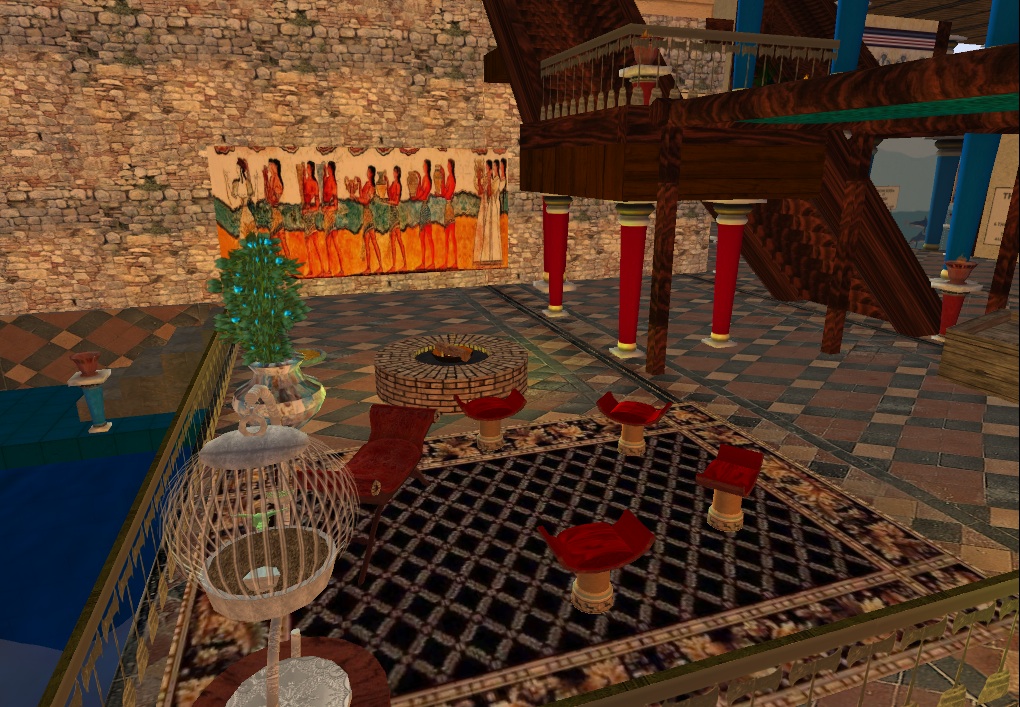
From there I visited the Vatican Library , an imposing replica of a beautiful hall of the library in Vatican City. Next I went over to the Mindan Museum. The story of the Minoan civilization of Crete and the Aegean Sea is told on boards around a build of the Palace of Knossos that shows the architecture of the time rediscovered in explorations of Crete in the late 18th century. See how lost history is recreated here .
The Chateau de Chenonceau is a replica of a famous castle on the Loire in France. Cedric Hansome donated his Second Life build to the museum when he retired to real-life. The grounds and the out buildings are charming . The Chateau itself is filled with period furniture and lovely art pieces. Roam the halls, climb the stairs, and open doors to view it all.
My last visit was to the Viking era Royal Residence at Tisso , Denmark. The contrast between this and the chateau are almost a shock when you arrive. A much different style of building and life .Outside the wooden wall there is a little library where you can see the reconstruction of the original site . There is so much detail to discover in this marvelous library that I will leave for you to find yourself. It would take reams of paper to describe everything .
QVINTVS said about the sim, “ I founded it and have some good friends, who are excellent builders. So I have the ideas and the archaeological groundplans and usually I am the person who gives the conferences mostly. And yes, sometimes a friend of us, also archaeologist, she is prof. at an American university, brings her rl students there sometimes.” It is well worth a visit go and experience .
http://maps.secondlife.com/secondlife/Buttercup%20Isle/128/113/3001
Gemma Cleanslate
Labels:
ancient,
archaeology,
Gemma Cleanslate,
Greece,
historical,
history,
Medieval,
Museum,
museums,
Places,
Rome,
Second Life,
secondlife,
sl
Wednesday, January 15, 2014
Myconos Island: A Greek Island in Second Life
By Bixyl Shuftan
Last month around Christmastime, I came across a resident named Artemis (artemisgreece). It turned out she was the owner of a Greek island sim in Second Life: Myconos. Artemis, whom is Greek herself, invited me to take a look at the place, so I went over.
Myconos, located at the Hellenic Island sim, is based on the real life island of Mykonos, which is a little more than thirty square miles and is in the South Aegean Sea between mainland Greece and Turkey. Second Life's Myconos is smaller, but has much of its Greek charm.
The entrance point takes one next to it's travel agency. At the time,
there was a Christmas tree there, but it was removed after the holidays.
Artemis showed me around, the two of us going down the town streets.
Among one of the first places she showed me was one of the Eastern Orthodox churches, based on a real one on the real life island. "See how peculiar it is?" Artemis asked me, "no corners, no wood. Just plaster." The inside had a number of Christian images.Our next stop was at a tavern near the ocean. Approaching it, we were greeted, "Welcome to KoutoukiTaverna." The building itself was used to store wine cask with most of the seating outside, reflecting that on the real life island, it doesn't rain much. There were a number of tables set up, each with some food and wine. There was a little space between them for dancing, and a small band area where people could play some instruments, a guitar, an electronic organ, and something native-looking in the middle chair. Artemis pointed to the middle one, "Bouzouki, a Greek instrument." She explained they were first made in ancient times.
We continued to go about the town, walking down it's streets. Artemis commented, "narrow streets with bougamvilleas, all white and blue." She stated this was a common sight on Mykonos in real life, "small houses with teraces." We then came across a tiny church, "and orthodox churches all around." This was the smallest in town, probably designed to seat less than a dozen people.Going further, we came across an arm wrestling table, then another tavern next to a creek with a recreation area with swings, a volleyball court that could keep score, an outdoor bar, and winsurfers and lounge chairs to sun oneself in.There was also a backgammon game on the beach.
Artemis and I soon parted, but I went back later. Going about this second time, I noticed other details that added to the atmosphere of the place. There were shops, such as the ice cream place with cookies and cakes as well. There was an occasional "artificial avatar" about to keep the place from looking empty. There were also local stalls where fruits and veggies as well as meat still on the hook and a bit bloody were on display. Across the island, the radio streams play a mix of rock and Greek music. One can be hearing a man singing in Greek one moment, and a few steps to the left be listening to "Green Day."
The place was well done. A nice tribute to the island it reflects. One can look up information about the real island at: http://en.wikipedia.org/wiki/Mykonos."Thank you soooo much for coming here. you are welcome any time. After all Greeks are famous for their hospitality."
Hellenic Island (13/202/23)
Bixyl Shuftan
Labels:
Artemis,
Bixyl Shuftan,
Greece,
Greek,
Hellenic Island,
Myconos,
Mykonos,
Places,
real life location,
Second Life,
secondlife,
sl
Monday, July 11, 2011
The Minoan Empire
The man behind Aeneas Anthony's avatar is a real life history teacher, one whose vision was to recreate the Minoan culture in 1500 B.C. The civilization had always fascinated him and since there wasn't a Minoan sim, he decided to create one.
Anthony reminds us that the Minoans were contemporaries of the ancient Egyptians. They appeared to be more peaceful than most ancient societies.
Here on Second Life, The Minoan Empire introduced participants to some of the
mythological elements that fit the ancient Greeks’ stories.
"About 95% of the structures were my design, based on photographs from archaeological excavations on Crete and Santorini (Thera)," explained Anthony. "In the past year, I was able to upgrade some of the textures and columns from wonderful creations by Alekso Minotaur and Airedale Magic. We use to have four regions joined together, which allowed for sailing. We also had a reconstruction of the Thera volcano for the first two years of the empire."
Anthony had a historical theme-based residential community. He states that there was a true roleplay environment there, other than in-character temple ceremonies led by priestesses.
Asked what fond memories he would carry with him during his future Second Life
experiences, Anthony replied that he enjoyed the building process during the first few months.
"Along the way, I also upgraded parts of the sim to make them more historical as I was able to do so," he said. "I also value many personal friendships that were developed here, and allowing so many good and interesting people to have a stage on which to interact in a peaceful and interesting environment."
As for his own involvement, Anthony created several different avatars and roles. He was the Royal Architect, and was responsible for the business aspect of the sim. As Minos Eracktor, King of Crete, he presided over the chariot races and supervised the court dancers in the Palace of Minos. On rare occasions, he portrayed some of the gods and the Minotaur in the Labyrinth.
In addition to all that he built, Anthony created a Museum of the Minoan Civilization.
This virtual introduction to an ancient culture was for many a first perspective. It kindled a social network of close friends, as well.
Having teleportated to the skybuild entryway to Ancient Crete, I was led to the heart of the city: the palace. I found my visit to be dedicated to the time period in greeting and attitude. My guide was Stroldor Demonia, the Governor of Crete, and her guard, Westley.They were in character and knowledgeable the majority of the tour. The tour was no less than 1 ½ hours. Demonia detailed the various highlights and Westley added his helpful comments.
A weekly chariot race on Sunday afternoons was the main activity and brought in non-members. A friendly beach party followed. There were 15 residences and a marketplace that featured time-appropriate furniture, clothing and structures.
According to Demonia, the majority of the meetings were held in the palace. There was the great hall or feast room, for large gatherings. The throne room was next door and the palace dance hall, upstairs. In the throne room, the King received foreign dignitaries and treasures from other nations the King had allied with.
"There is definitely a lot of history within these walls," said Demonia, and then she led me out of the palace. "Down there is the labyrinth where the Minotaur resides. It is a maze filled with perils at every turn. Only the bravest find their way out," she said before she leads me to the dance hall. “Group members had many formal events in the dance hall. Above it was the King's private residence.”
Shortly after, we stand on a terrace that overlooks the city. I view the many special areas where members shared their hours.
There are two highlights that focus on the spiritual aspects of the Minoan culture.
Ceremonies rotated around the temples. One is the Bull Temple that stands above the city. Here ceremonies were held every night.
"This is the mighty bull, the incarnation of Zeus, father to our beloved King Minos," she explains. "This is how he manifested himself to Europa mother of King Minos. He is known as the god of virility, with grace and stamina.
Westley continues by telling me that Zeus abducted the Phoenician princess, Europa, disguised as a bull, and then carried her on his back to the island of Crete where she bore him three sons: Minos, Rhadamanthys and Sarpedon. As per the records, not his words, he notes.
The other ceremonial site is the Temple of Poseidon. Demonia stated that they had
ceremonies daily at noon and 5 p.m. sl on weekends.
"This is Poseidon, the ruler of the waves and earth shaker," explained Demonia. "He protects our ships as they are our only way of trade.”
"Voyages were dangerous," I added.
"Yes, they were, and the only way to trade our goods and bring in much needed food that we could not supply ourselves," she replied.
We then wandered down to an area that honored Europa, the Moon goddess, queen of tides, giver of dew and moisture; she also was mortal, which made King Minos a demigod.
Onward we move to Earth Mother, the breath of life for everything.
"Hence the statue is bare breasted," said my guide. "The ladies of Crete honor her by revealing their breasts. There are many ancient pictures that depict this. The most famous are the three ladies.”
Next came the Council of Resident's Hall, where discussions were held about what they would like to happen within the community.
In the Hall of Nations many peace treaties were signed. Demonia mentioned that the real civilization was the only nation that treated women equal to men.
"Women were not just regarded as homemakers. They were actively encouraged to
participate within the political system," she told me.
The last stop on the tour is the chariot viewing stand. The track was around the island rather than a circle. She also noted how the beach was a great place for everyone to chat and catch up.
This special historical build was in existence for over 3 years. Anthony’s attention to
detail was amazing and it was his passion, according to Demonia and many visitors would agree. Though the sim is now closed, an "exile community" will continue with the chariot races and dances on the beach of a different adult sim.
Here’s the landmark: http://slurl.com/secondlife/Darwins%20Arch/33/223/22.
Netera Landar
Editor's Note: Netera sent over a notecard separate from the article announcing their new location. It's included as the Minoan's epilouge.
Khaire Fellow Minoans,
The tsunami devastated our land... a few of us survived and have made an exile community, we had some items wash up on shore with us...
We are going to continue with the Chariot Races and celebrate that Earth Mother spared us by dancing afterwards at the beach in traditional style....
Hope all survivors make their way here, we look forward to seeing you all...
Anthony reminds us that the Minoans were contemporaries of the ancient Egyptians. They appeared to be more peaceful than most ancient societies.
Here on Second Life, The Minoan Empire introduced participants to some of themythological elements that fit the ancient Greeks’ stories.
"About 95% of the structures were my design, based on photographs from archaeological excavations on Crete and Santorini (Thera)," explained Anthony. "In the past year, I was able to upgrade some of the textures and columns from wonderful creations by Alekso Minotaur and Airedale Magic. We use to have four regions joined together, which allowed for sailing. We also had a reconstruction of the Thera volcano for the first two years of the empire."
Anthony had a historical theme-based residential community. He states that there was a true roleplay environment there, other than in-character temple ceremonies led by priestesses.
Asked what fond memories he would carry with him during his future Second Life
experiences, Anthony replied that he enjoyed the building process during the first few months.
"Along the way, I also upgraded parts of the sim to make them more historical as I was able to do so," he said. "I also value many personal friendships that were developed here, and allowing so many good and interesting people to have a stage on which to interact in a peaceful and interesting environment."
As for his own involvement, Anthony created several different avatars and roles. He was the Royal Architect, and was responsible for the business aspect of the sim. As Minos Eracktor, King of Crete, he presided over the chariot races and supervised the court dancers in the Palace of Minos. On rare occasions, he portrayed some of the gods and the Minotaur in the Labyrinth.
In addition to all that he built, Anthony created a Museum of the Minoan Civilization.
This virtual introduction to an ancient culture was for many a first perspective. It kindled a social network of close friends, as well.
Having teleportated to the skybuild entryway to Ancient Crete, I was led to the heart of the city: the palace. I found my visit to be dedicated to the time period in greeting and attitude. My guide was Stroldor Demonia, the Governor of Crete, and her guard, Westley.They were in character and knowledgeable the majority of the tour. The tour was no less than 1 ½ hours. Demonia detailed the various highlights and Westley added his helpful comments.
A weekly chariot race on Sunday afternoons was the main activity and brought in non-members. A friendly beach party followed. There were 15 residences and a marketplace that featured time-appropriate furniture, clothing and structures.
According to Demonia, the majority of the meetings were held in the palace. There was the great hall or feast room, for large gatherings. The throne room was next door and the palace dance hall, upstairs. In the throne room, the King received foreign dignitaries and treasures from other nations the King had allied with.
"There is definitely a lot of history within these walls," said Demonia, and then she led me out of the palace. "Down there is the labyrinth where the Minotaur resides. It is a maze filled with perils at every turn. Only the bravest find their way out," she said before she leads me to the dance hall. “Group members had many formal events in the dance hall. Above it was the King's private residence.”Shortly after, we stand on a terrace that overlooks the city. I view the many special areas where members shared their hours.
There are two highlights that focus on the spiritual aspects of the Minoan culture.
Ceremonies rotated around the temples. One is the Bull Temple that stands above the city. Here ceremonies were held every night.
"This is the mighty bull, the incarnation of Zeus, father to our beloved King Minos," she explains. "This is how he manifested himself to Europa mother of King Minos. He is known as the god of virility, with grace and stamina.
Westley continues by telling me that Zeus abducted the Phoenician princess, Europa, disguised as a bull, and then carried her on his back to the island of Crete where she bore him three sons: Minos, Rhadamanthys and Sarpedon. As per the records, not his words, he notes.
The other ceremonial site is the Temple of Poseidon. Demonia stated that they had
ceremonies daily at noon and 5 p.m. sl on weekends.
"This is Poseidon, the ruler of the waves and earth shaker," explained Demonia. "He protects our ships as they are our only way of trade.”
"Voyages were dangerous," I added.
"Yes, they were, and the only way to trade our goods and bring in much needed food that we could not supply ourselves," she replied.
We then wandered down to an area that honored Europa, the Moon goddess, queen of tides, giver of dew and moisture; she also was mortal, which made King Minos a demigod.
Onward we move to Earth Mother, the breath of life for everything.
"Hence the statue is bare breasted," said my guide. "The ladies of Crete honor her by revealing their breasts. There are many ancient pictures that depict this. The most famous are the three ladies.”
Next came the Council of Resident's Hall, where discussions were held about what they would like to happen within the community.
In the Hall of Nations many peace treaties were signed. Demonia mentioned that the real civilization was the only nation that treated women equal to men.
"Women were not just regarded as homemakers. They were actively encouraged toparticipate within the political system," she told me.
The last stop on the tour is the chariot viewing stand. The track was around the island rather than a circle. She also noted how the beach was a great place for everyone to chat and catch up.
This special historical build was in existence for over 3 years. Anthony’s attention to
detail was amazing and it was his passion, according to Demonia and many visitors would agree. Though the sim is now closed, an "exile community" will continue with the chariot races and dances on the beach of a different adult sim.
Here’s the landmark: http://slurl.com/secondlife/Darwins%20Arch/33/223/22.
Netera Landar
Editor's Note: Netera sent over a notecard separate from the article announcing their new location. It's included as the Minoan's epilouge.
Khaire Fellow Minoans,
The tsunami devastated our land... a few of us survived and have made an exile community, we had some items wash up on shore with us...
We are going to continue with the Chariot Races and celebrate that Earth Mother spared us by dancing afterwards at the beach in traditional style....
Hope all survivors make their way here, we look forward to seeing you all...
Labels:
Aeneas Anthony,
ancient,
chariot,
Crete,
Greece,
Greek,
historical,
history,
Mioan,
Netera Landar,
race,
roleplay,
RP,
Second Life,
secondlife,
sl,
Stroldor Demonia
Subscribe to:
Posts (Atom)